
AI & SECURITY / CHANGING ATTACK ECONOMICS
One malicious core.
Many disposable variants.
Why cheaper iteration changes the economics of malware—and the evidence your defences need to produce.
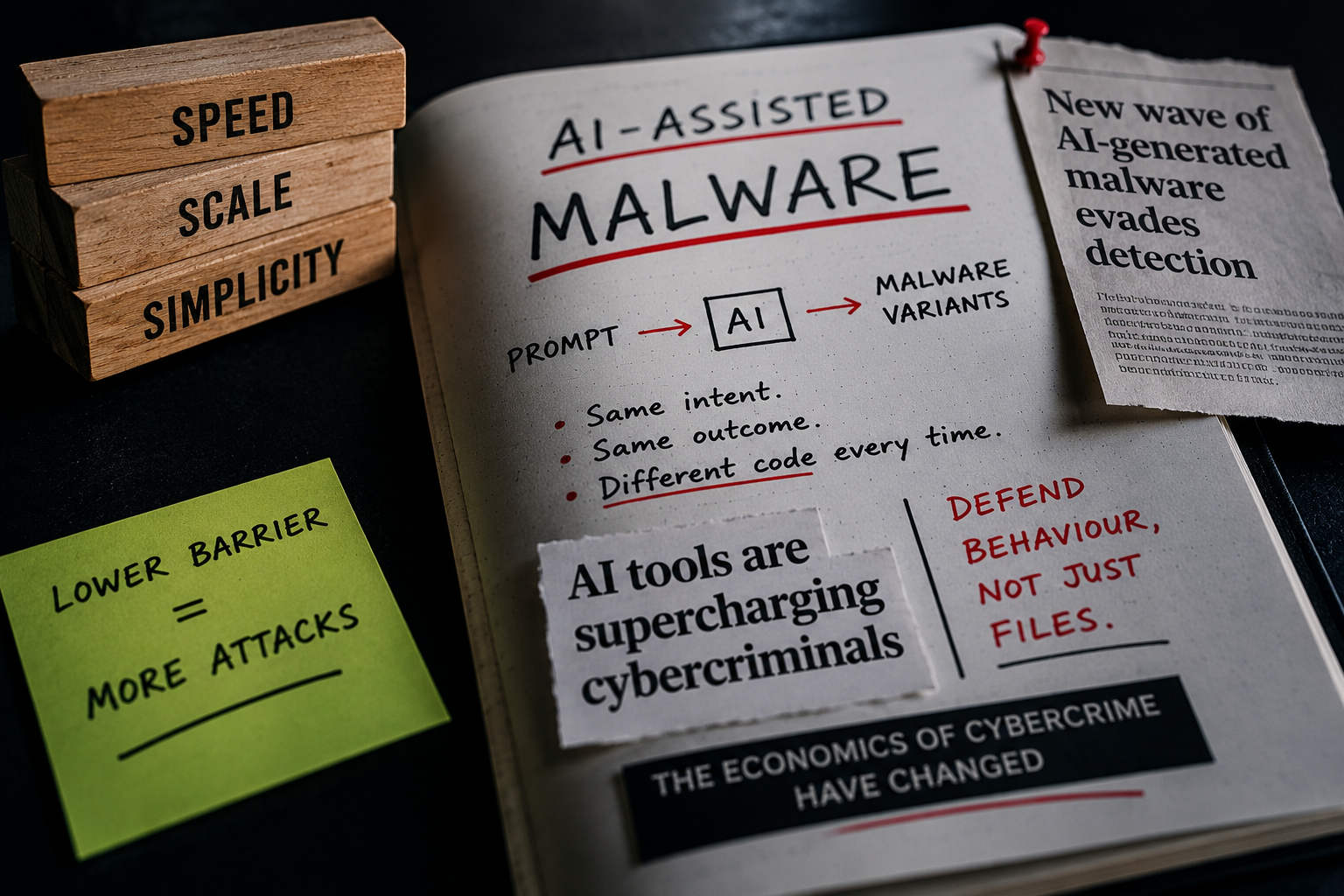
AI-assisted malware does not have to be brilliant to become a serious business problem. If a criminal can produce, repackage, and distribute workable variants more cheaply, a stretched security team faces more opportunities for something to be missed—even when the underlying technique is familiar.
That is the original article’s central argument: take the economics of scale seriously. It is not a claim that AI can never improve sophistication. Capable operators can benefit too, and the evidence needs to distinguish production assistance, laboratory demonstrations, and malware used in live operations.
THE EXECUTIVE BRIEF
Spend against the operating problem.
- Keep established anti-malware protection, and test how well the organisation detects relevant activity when a file is unfamiliar.
- Treat a flood of varied samples as a workload and coverage problem, not proof that every sample is technically advanced.
- Ask what the evidence actually shows: a scoped experiment, an observed campaign, or an experimental capability.
01
The cost of variation is falling.
Defenders have often benefited from attackers reusing familiar components. Reuse creates recognisable patterns, allowing one detection to help catch later samples. AI-assisted coding can weaken that advantage by changing the code’s structure without necessarily changing its purpose.
For management, the consequence is not simply “more malware”. It is more variation to classify, more alerts to investigate, and more opportunities to exploit gaps between teams or tools. The cost of an unsuccessful attempt can remain low enough for the attacker to keep trying.
Lower barriers can make less experienced operators more productive without turning them into expert intrusion teams. More capable groups gain a different advantage: less time spent on repetitive engineering and more capacity to adapt existing work. Both effects can increase the pressure on defenders, even when the individual techniques are familiar.
That does not make the attacker’s marginal cost literally zero, or establish that every generated sample will work. It changes the question worth asking: are the controls effective against the activity and the exposure, or only against a set of files they already recognise?
02
A narrow experiment illustrates an important mechanism.
Researchers at University College Cork examined AI-generated malicious shell-script permutations. Their peer-reviewed paper reports that code structure varied while runtime behaviour remained largely consistent; dynamic and behavioural techniques were more robust than the static approaches tested.
The scope matters. This was research into a particular malware class, including scripts associated with Linux-based connected devices—not proof that every signature will fail against every AI-written program.
WHAT CHANGES
The appearance of the code.
01
Renamed
02
Reordered
03
Restructured
04
Repackaged
05
Reworded
06
Rewritten
Different-looking samples can preserve the same malicious intent.
WHAT DEFENDERS CAN EXAMINE
The activity needed to achieve it.
- Unexpected process activity
- Suspicious script execution
- Attempts to retain access
- Unusual access to information
- Outbound activity in context
Behavioural evidence can survive changes in the code’s appearance. It still needs coverage, context, and a response.
Conceptual comparison informed by the Cork research. These are examples of defensive observations, not a universal sequence or a guarantee that every action will be visible.
The useful procurement test follows from the distinction. A demonstration that recognises known samples does not establish coverage of unfamiliar activity. Ask the team to show what it can observe, which relevant behaviours are tested, what remains invisible, and how a supported finding reaches someone authorised to act.
03
One campaign shows what scale looks like.
OBSERVED CAMPAIGN / JANUARY 2026
Volume was the operating model.
443
Malicious ZIP archives
48
Unique loader variants
1,700+
Different lure filenames
100+
Distribution URLs
Source: McAfee Labs, published 18 March 2026. Counts refer to one campaign observed in January; they are not estimates of all AI-assisted malware or numbers of successful infections.
McAfee’s analysis found large numbers of software lures around a smaller set of underlying loaders. Its assessment of AI assistance concerned particular components, especially scripts; it did not establish that an AI system autonomously designed or ran the entire campaign.
Nor are the four counts interchangeable. A ZIP archive is a package, a loader variant is a distinct malicious component, a lure filename is a presentation, and a URL is a distribution route. They cannot be added together as a single “attack total”.
The business lesson is the mismatch in effort. A campaign can offer many apparently different entry points while reusing much of the machinery behind them. Blocking a named file remains useful, but it does not settle the risk from the next package, another download location, or an endpoint outside monitoring coverage.
04
Separate AI-assisted development from runtime AI.
AI can help produce software before it is deployed; some malware also calls a model while it runs. Google Threat Intelligence Group’s November 2025 report documents both operational evidence and experimental work. Those are different levels of maturity.
| Family | What Google reported | Why the distinction matters |
|---|---|---|
| PROMPTSTEAL | Observed in APT28 operations against Ukraine; queried an LLM to generate commands during execution. | A documented live use case, not evidence that every stage of an intrusion was autonomous. |
| PROMPTFLUX | Experimental self-modifying dropper; Google assessed it was not then capable of compromising a victim device or network. | A development-stage capability should not be presented as an established operational threat. |
Even when code adapts, achieving an objective usually still involves activity on a device, an identity, or a network. That gives defenders opportunities, not certainty: sensor coverage, visibility into legitimate tools, false positives, and the speed of response all affect whether suspicious activity is recognised in time.
The measured position is to take the evidence seriously without buying an autonomous-warfare story. Dismissing all AI-assisted malware as poor-quality output is as unhelpful as assuming that an AI label makes it unstoppable.
05
Strengthen the controls that make scale less profitable.
A sensible response combines prevention, behavioural monitoring, identity controls, and rehearsed response. It does not discard antivirus, and it does not assume that purchasing endpoint detection and response will automatically deliver the desired outcome.
Coverage
Know which devices and workloads are monitored.
Find unsupported systems, unmanaged endpoints, and gaps in alert handling before relying on a coverage percentage.
Execution
Reduce unnecessary opportunities to run code.
Use application control where practical; restrict and log scripting, harden Office and macro use, and keep exceptions owned.
Privilege
Limit what a successful execution can reach.
Review administrative access, service identities, and separation between ordinary work and sensitive operations.
Exposure
Close usable routes into the business.
Prioritise vulnerabilities in context, protect exposed services, and keep emergency change decisions ready.
Detection
Test activity, not just filenames.
Examine suspicious process relationships, persistence attempts, and outbound traffic in context. An AI-service connection alone is not proof of compromise.
Response
Turn evidence into an effective decision.
Agree isolation authority, escalation, investigation support, and recovery arrangements. Exercise them together.
Endpoint and extended detection and response (EDR/XDR), central event monitoring, and disciplined threat hunting can each contribute to that operating model. Their value depends on what they cover and who investigates the evidence. Collecting activity without the context or authority to act is not an effective detection strategy.
A behavioural model such as MITRE ATT&CK can help organise the coverage conversation. Mapping a rule to a technique is not evidence that every instance will be detected: test the relevant situation, record the result, and retain the limits of the test.
Include the cost of false positives and investigation time in any product evaluation. More alerts are not an improvement if they prevent the team from finding the event that threatens an important business service.
THE CYBERSOLACE PERSPECTIVE
Make the defence harder to overwhelm.
Cheap variation changes the attacker’s economics. Your answer should make familiar techniques less productive and suspicious activity easier to investigate, whatever tool helped produce the code.
At the next review, ask for one demonstration of end-to-end coverage: an unfamiliar sample or authorised behavioural test, a supported detection, an accountable decision, and a contained business consequence. Use that evidence to decide the next improvement.
THE EVIDENCE STANDARD
Ask what the claim demonstrates.
A laboratory result, a campaign report, and a product demonstration answer different questions. Use each for the conclusion it can support, and ask where visibility, investigation capacity, or authority would still limit the response.
SOURCES & EDITORIAL REVIEW
Original publication date retained; research and presentation reviewed 20 October 2026. Source findings are distinguished from CyberSolace’s operational interpretation.