
ANNUAL REVIEW / 2025 IN PERSPECTIVE
Keep the lessons.
Revisit the predictions.
A retrospective is useful when it changes the next operating decision.
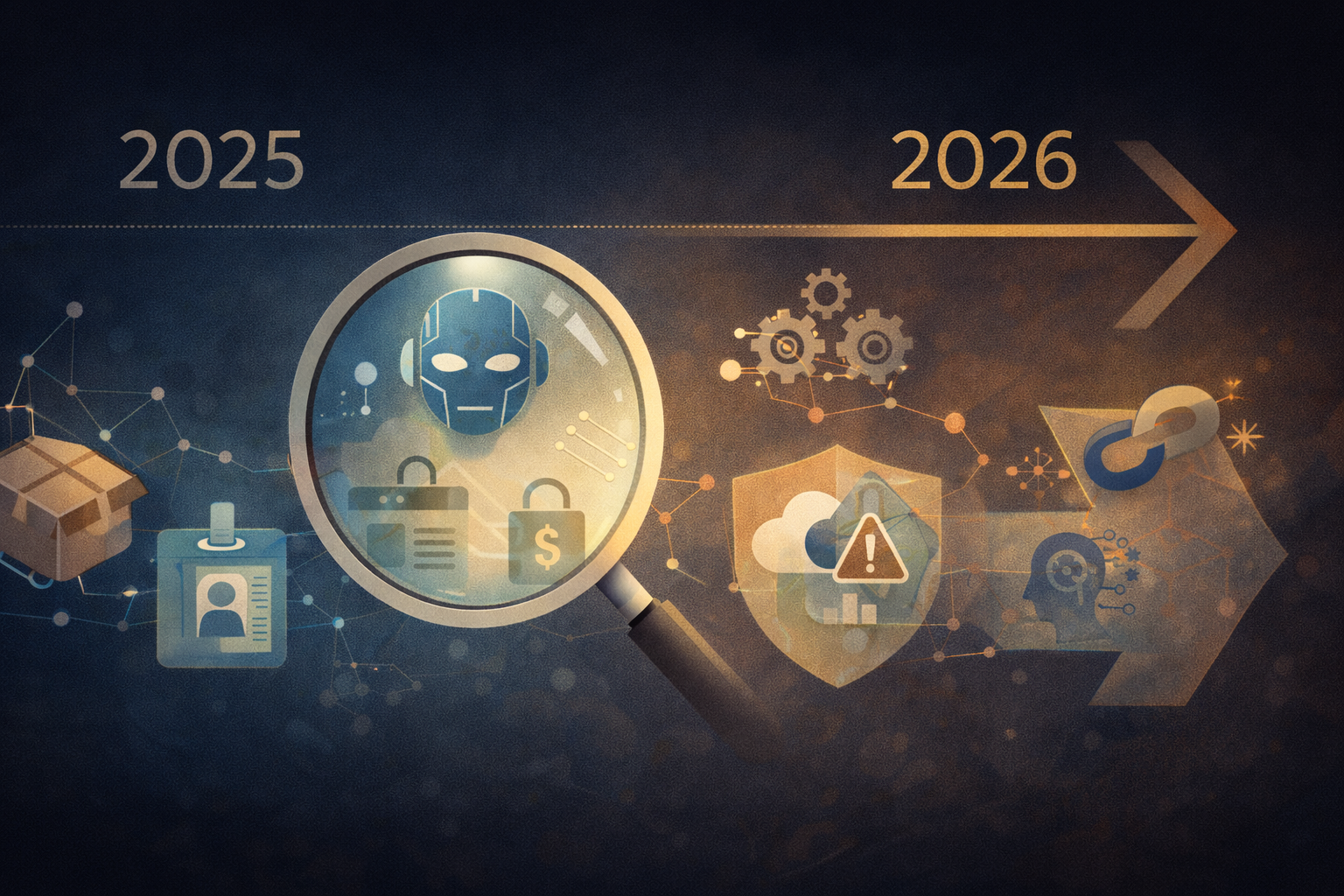
The most useful way to read 2025 is through the authority organisations delegated: to people, software integrations, support processes, and increasingly AI assistants. Attackers did not always need to exploit a new software flaw to use that authority against the business.
The cases below retain their dates and scope. The year-end outlook is a planning perspective on 2026, rather than a claim that every predicted event has now happened.
THE EXECUTIVE BRIEF
The decisions that matter.
- Inventory delegated authority, including integrations and crisis access.
- Make verification and revocation practical during ordinary work and disruption.
- Read headline figures with their date, population, and measurement attached.
THE YEAR IN CASE FILES
Trust was an operational dependency.
On 30 December 2025, the US Department of Justice announced guilty pleas by two cybersecurity professionals for participation in ALPHV/BlackCat ransomware attacks. Their professional experience makes the case especially troubling. The announcement does not establish that they were the incident responders hired by each victim they attacked.
The governance lesson is to control consequential access even when a person has relevant expertise and an urgent job to do. Incident response arrangements should establish authorisation, logging, expiry, and conflicts of interest before an emergency. Trust in professional competence and control over access address different questions.
Another form of delegated authority became visible in Cloudflare’s account of the Salesloft Drift incident. Compromised integration credentials were used to access Salesforce information. The relevant boundary was a third-party connection and its permissions; describing it simply as a failure to choose a strong user password would miss the mechanism.
A business should know what an integration can read or change, who owns it, and how it can be revoked without waiting for its original installer. The approval made when an application was connected may still be operating long after the original business need has changed.
HELPFUL INSTRUCTIONS / HARMFUL AUTHORITY
Support processes can carry an attacker’s request.
ClickFix-style attacks ask a person to carry out a harmful action under the pretext of solving a technical problem. The wider insight is behavioural: a convincing support instruction can borrow authority from the user’s desire to repair an error and return to work.
Help-desk impersonation poses a related problem. If a caller can persuade support to reset a consequential account, the password itself is only one part of the control. The recovery process, identity evidence, approval route, and ability to refuse an exceptional request matter as much as ordinary sign-in.
Training still has a role. It should be connected to an easy way to verify support instructions, a policy that permits a pause, and technical restrictions on consequential actions. Calling all awareness training obsolete would discard a useful control while leaving the approval process unchanged.
TWO EVERYDAY MOMENTS TO REHEARSE
Make the legitimate route easier to recognise.
REPAIR REQUEST
An unexpected page tells you how to fix the computer.
Use the known support route. Staff should be able to verify the instruction without following it first or supplying secrets.
ACCESS REQUEST
A persuasive caller needs an urgent account reset.
Use the established recovery evidence and escalation process. A claimed senior role must not become an exemption.
CyberSolace exercise prompts. These are illustrative situations, not an instruction to run commands from an untrusted page.
AI / CONTENT & INSTRUCTIONS
An assistant can cross a boundary the user cannot see.
The EchoLeak case study describes CVE-2025-32711, a zero-click prompt-injection vulnerability in Microsoft 365 Copilot. Researchers demonstrated how malicious content could cause information to leave the assistant’s intended boundary. The public research concerns a flaw in a production product; it is not evidence that a named customer suffered the demonstrated theft.
The important distinction is between information the assistant should examine and authority it should obey. Content from an email or retrieved document should not acquire the power to redirect an assistant merely because the assistant can read it.
For deployment, ask what the assistant can access, what it can send or change, and which actions require an independently authorised decision. Restricting unnecessary data access and separating reading from consequential actions can reduce impact. A supplier’s remediation of one flaw is not an enduring guarantee that every possible prompt-injection technique has been solved.
THE NUMBERS / WHAT THEY ACTUALLY MEASURE
Large figures need a denominator and a date.
THREE DIFFERENT MEASUREMENTS
Compare the meaning before comparing the size.
ABOUT $1.5BN
A theft attributed in February 2025
The FBI attributed the Bybit theft to North Korea. This is an incident estimate, not a measure of every organisation’s likely loss.
29.7 TBPS
A provider’s Q3 2025 DDoS observation
Cloudflare reported this peak in its third-quarter account. A dated provider observation is not a permanent global record.
33% DOWN
UK core cyber job postings, 2024 versus 2023
The government’s 2025 labour-market study measured a decline in core job postings. It did not measure a one-third loss of the entire workforce.
Different units, populations, and periods. The figures are deliberately presented as separate records, without a misleading shared axis.
The sources are the FBI’s Bybit attribution, Cloudflare’s Q3 2025 report, and the UK government’s 2025 skills study. None establishes that employment pressure caused professionals to commit ransomware offences, or that the largest reported attack is the right capacity target for every business.
Use figures to ask a better operational question. For payment approval, who can independently validate the destination? For service availability, what demand or interruption can the business tolerate? For staffing, which essential capabilities are missing and what coverage is actually available?
FIVE QUESTIONS FOR THE BOARD
Move from confidence to evidence.
- What do we trust? Identify the suppliers, people, integrations, and automated workflows carrying authority, and the business owner of each.
- Who or what can act on our data? Include non-human identities and assistants, their permissions, and the route to change them.
- How would misuse become visible? Connect identity, data-access, and application records to business context; do not assume every malicious action will look technically unusual.
- What changes during a crisis? Make emergency access temporary and auditable, with independently checked payment and approval decisions.
- What does assurance actually demonstrate? Identify the process and period examined, unresolved exceptions, and the operational test still needed.
Compliance evidence remains useful. Its limits should be explicit: the scope of an audit, the date it covers, and the relationships it did not examine. Dismissing all compliance as yesterday’s paperwork would be as unhelpful as treating it as proof of continuous security.
READING THE OUTLOOK IN OCTOBER 2026
Keep a forecast separate from an observed event.
Further abuse of normal connections, support requests, and automated work was a plausible concern entering 2026. That is a planning hypothesis, not proof that every new incident followed the same pattern. Keep an incident account, a research demonstration, a measurement, and a forecast visibly distinct.
For the next management review, select one consequential trust relationship and trace its lifecycle: business purpose, approval, permissions, monitoring, emergency use, and termination. Look for a point where everyone assumes somebody else owns the decision.
The lasting insight from 2025 is not that trust must disappear. It is that delegated authority needs an owner, an observable purpose, and a practical way to withdraw it. Those are operating requirements a business can examine today.
A PRACTICAL NEXT STEP
Review the authority behind one ordinary workflow.
CyberSolace can help turn supplier, identity, and automation assumptions into a practical assurance review.
SOURCES & EDITORIAL REVIEW
Historical findings and incident accounts are dated in the text. Illustrative review prompts are CyberSolace commentary. Editorial review: 20 October 2026.