
Embracing Zero Trust: A Strategic Cybersecurity Consideration for Modern Businesses
A business view of identity, access and the decisions behind Zero Trust.
The starting point
A business perspective.
In today’s complex digital landscape, traditional perimeter-based security is no longer sufficient. The rise of cloud computing, mobile workforces, and sophisticated cyber threats has rendered the conventional “trust once inside” model obsolete. This is where Zero Trust Architecture (ZTA) emerges as a critical cybersecurity strategy, fundamentally shifting how organizations protect their valuable assets.
01 / Rethink the perimeter
The Cracks in the Conventional Armor
Historically, cybersecurity focused on building strong defenses around the network perimeter. Once a user or device was “inside,” they were largely trusted and granted broad access to corporate resources. However, this approach has proven vulnerable.
Malicious actors can originate from both inside and outside the perimeter, and recent high-profile cyberattacks have starkly demonstrated the limitations of this model. Furthermore, the very concept of a defined perimeter is fading with the pervasive adoption of cloud services and increased workforce mobility.
02 / The access decision
What is Zero Trust?
Zero Trust is a cybersecurity strategy that abandons the implicit trust associated with traditional perimeters. Instead, it moves towards narrow, dynamic, and risk-based access control for all enterprise resources, regardless of their location. Access decisions are continuously evaluated based on multiple attributes, including user identity and endpoint health.
In essence, Zero Trust operates on the principle of “never trust, always verify.”
03 / Business value
Why Zero Trust is a Business Imperative
Implementing a Zero Trust Architecture offers compelling benefits for businesses looking to bolster their security posture and operational resilience:
- Enhanced Protection: Zero Trust protects business assets and processes whether they are on-premises or cloud-based.
- Mitigating Insider Threats: It significantly limits the insider threat by not automatically trusting internal users or non-person entities.
- Limiting Breaches: By restricting lateral movement and privilege escalation within the environment, ZTA reduces the attacker’s ability to compromise systems more deeply.
- Data Security: Sensitive corporate information is better protected through integrated data security solutions.
- Improved Visibility and Control: ZTA enhances visibility into resource inventory, configurations, communication flows, and access patterns, allowing for the formulation and enforcement of more effective security policies.
- Flexible Access: It supports user access to resources regardless of their location or device type (managed or unmanaged).
- Continuous Monitoring: Zero Trust enables real-time and continuous monitoring, logging, and policy-driven, risk-based assessment and enforcement of resource access policies.
04 / Plan the change
Navigating the Implementation Journey
While the benefits are clear, implementing a ZTA is not without its challenges. Businesses often face hurdles such as:
01
Leveraging Existing Investments:
Integrating ZTA with existing infrastructure and balancing this with modernization initiatives can be complex.
02
Technology Integration:
Assessing and integrating various commercially available technologies of varying maturities, and identifying gaps, requires careful planning.
03
Operational Impact Concerns:
There can be concerns that ZTA might negatively impact existing operations or the end-user experience.
04
Lack of Common Understanding:
A significant challenge is often a lack of shared understanding of ZTA across the organization, making it difficult to gauge maturity, determine the most suitable approach, and develop an effective implementation plan.
05 / From principle to architecture
The National Cybersecurity Center of Excellence (NCCOE) Leading the Way
Recognizing these challenges, the National Cybersecurity Center of Excellence (NCCOE) is actively addressing the implementation of ZTA through collaborative efforts with industry and the IT community. Their project aims to demonstrate practical ZTA solutions applied to conventional enterprise IT infrastructures, designed according to the concepts outlined in NIST Special Publication (SP) 800-207, Zero Trust Architecture.
The NCCOE, a part of NIST, is a collaborative hub that brings together industry, government, and academia to develop modular, adaptable cybersecurity solutions using commercially available technology, applying standards and best practices.
ZTA HIGH-LEVEL ARCHITECTURE
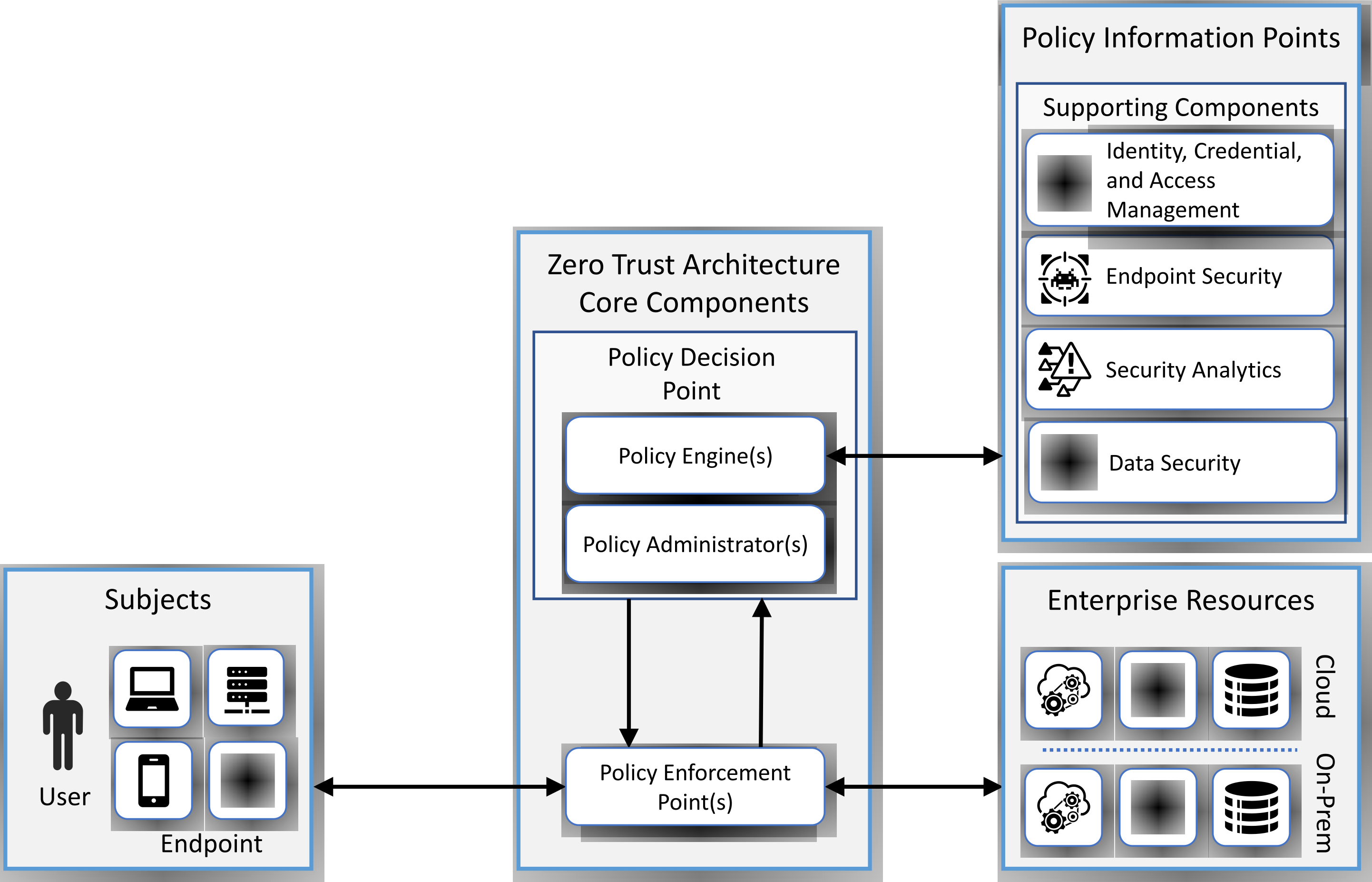
Use the expand control to inspect the original diagram.
The NCCOE’s work provides valuable guidance and example solutions to help organizations navigate the complexities of ZTA adoption, ultimately making this powerful security strategy more accessible and actionable for businesses of all sizes.
A strategic consideration
Embracing a Zero Trust Architecture is a helpful option and a strategic consideration for businesses seeking to build resilient and secure digital environments in the face of evolving cyber threats.