
Tools & Resources / Ransomware / Leadership readiness
Ransomware Readiness for Senior Leaders: A Simple, Quick Assessment
Bring governance, information protection, technical and human safeguards into one readiness conversation.
01 / Ransomware
Stop Guessing: How Ready Are You to Respond When Ransomware Strikes?
Ransomware isn’t just an IT problem anymore – it’s a fundamental business survival issue. It’s getting faster, smarter, and more disruptive, capable of halting operations, causing significant financial loss, and damaging your reputation in moments.
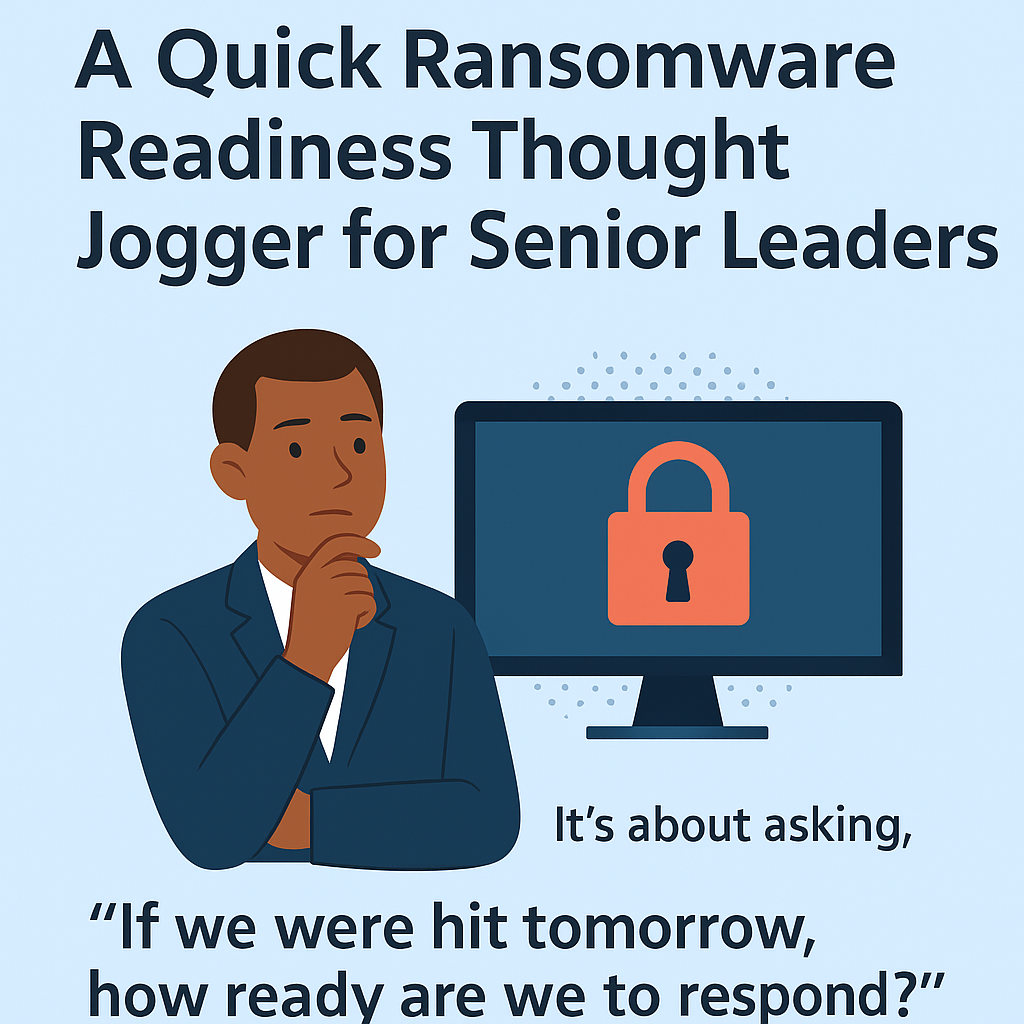
As a senior leader, you don’t have time for lengthy technical whitepapers. What you need is clarity: “If our organisation were hit by ransomware tomorrow, how ready are we, really, to handle it?”
This simple readiness check is not an audit. It’s not a complex framework. It’s designed to be a light-touch ‘thought jogger’ – a quick way for executives and senior managers to gain a high-level perspective and, crucially, start essential conversations about your organisation’s ability to detect, contain, and recover from a ransomware incident.
Interactive / Self-assessment
Start your ransomware readiness conversation.
Use the short assessment to look across the four pillars of readiness.
Opens in a modal. Your answers stay in the assessment.
The Four Pillars of Ransomware Readiness
Effective ransomware readiness isn’t just about technology. It’s a blend of governance, protection, technical controls, and human factors. We’ve distilled the essentials into four key pillars. Feeling confident in these areas means you’re already building a strong defense:
View the original supporting illustration
01
Governance:
- Does accountability for ransomware risk sit clearly with senior leadership or the board?
- Are roles, responsibilities (including incident response), and relevant policies clearly defined and communicated?
- Is ransomware risk regularly discussed at the board or executive level?
- Why it matters: Readiness starts with leadership and clear directives.
02
Information Protection:
- Do you have a clear understanding of your most critical data assets and where they reside?
- Is there a robust backup strategy in place for critical data?
- Are backups stored offline (air-gapped) to prevent them from being encrypted by the ransomware itself?
- Are your backup recovery procedures regularly tested and validated?
- Why it matters: Your data is the target; effective, tested backups are your last line of defense against paying a ransom.
03
Technical Safeguards:
- Are systems and software consistently patched and updated to close known vulnerabilities?
- Are endpoints (computers, servers) adequately monitored for suspicious activity?
- Is the network segmented to limit the potential spread of ransomware if one part is compromised?
- Are security tools configured to actively block known ransomware behaviors?
- Why it matters: Strong technical hygiene reduces your attack surface and increases detection capabilities.
04
Human Safeguards:
- Are staff regularly trained to recognize and report phishing attempts and other suspicious activities (the most common initial attack vector)?
- Is multi-factor authentication (MFA) enforced, especially for remote access and privileged accounts?
- Have you rehearsed your ransomware incident response plan through simulations or tabletop exercises in the last year?
- Why it matters: Your people are both a key defense and a potential vulnerability; awareness and practice are crucial.
02 / Ransomware
How to Use This Simple Tool
The tool guides you through a short series of questions (around 14), linked to the control areas within these four pillars.
For each question, you provide a self-assessment score from 0 to 4:
- 0 = Not Started: No significant effort or confidence in this area.
- 1 = Exploring: Starting to think about or investigate solutions/policies.
- 2 = Partially Implemented: Some controls or policies are in place but not consistently or comprehensively across the organisation.
- 3 = Mostly Operational: Controls and policies are largely in place and functioning, though minor gaps may exist.
- 4 = Fully Operational & Optimised: Controls and policies are robust, consistently applied, regularly reviewed/tested, and integrated into operations.
Calculate your average score to get a high-level indication of your current readiness – highlighting areas of strength and those needing urgent attention.
03 / Ransomware
Examples of Questions You’ll Consider:
- “Do we have an up-to-date, documented ransomware incident response plan?”
- “Are critical data backups stored offline and tested regularly for successful recovery?”
- “Is multi-factor authentication enforced across all remote access and privileged user accounts?”
- “Have we conducted a simulated ransomware response exercise involving relevant teams in the last 12 months?”
04 / Ransomware
The Takeaway: Start the Conversation
Remember, this is a thought jogger, not a pass/fail compliance audit. You don’t need to score a perfect 4 on every question. The real value is in holding up the mirror and asking: “Are we prepared?”
The most important step is initiating this vital conversation within your leadership team based on your assessment.
Ready to take that first step towards clearer ransomware readiness?
Your assessment is completely confidential – no information is stored or shared by CyberSolace.
Try it yourself by opening the assessment using the button below, then selecting Start assessment.
It only takes a few minutes – and may kick off the most important security conversation your team has all year.